w2 - cooking with gas
- Sophia Schulz
- Mar 7
- 13 min read

Updated: Mar 12
DESN800 // 10/03/26
Intentions for This Week's Making
This week, with a call to be more intentional with our making of the 16 artefacts, I decided to first return back to my original research proposal and reflect on the ways in which the first week's making aligned with my research intentions and what aspects I should explore next.
The following were my notes from this reflection exercise, with green highlights indicating areas I covered in the previous week of making and red highlights indicating areas I hadn't covered and wanted to explore next:
GENERAL RESEARCH SPACE: interactive (and immersive) installations in publicly accessible space
methods of interaction existing in a 3-dimensional realm
adding dimensionality beyond 2D interfaces
eg. 3D interfaces, objects you can grasp and move around, etc.
engaging multiple senses
touch/tactility, sight, hearing
exploring materiality of interfaces
improving immersion through 3-dimensional interaction
same points as above
incorporating a sense of play
how play is used in education and storytelling (especially for young children)
loss of play as you get older
transforming public space
creating useful spaces out of previously unused/under-utilised spaces
publicly accessible
focus on urban spaces?
using live/real-time data to drive the experience
eg. driving the feedback experience from the installation (visuals, sound, etc.)
eg. communicating/educating on a concept and/or telling a story
data that reflects the space/environment that the installation inhabits and/or used to transform the space (could be data used elsewhere that changes the space itself)
exploring how the data is translated into different means and used for interaction + immersion
fostering connections (and/or community) between people and their environment
loss of connection and community especially in urban environments
exploring how spaces can generally foster connection (eg. creating community, sense of identity with the environment and its people, etc.)
exploring how interactive installations can transform spaces to foster this connection in under-utilised spaces
storytelling and/or education driven
using interactive/immersive installations as a medium for storytelling or education
storytelling/education could also tie in with connection/community, eg. educating about a subject and empowering action from participants
How this relates to what I explored in W1:
translating environmental data into visual media
sound recordings taken around campus + albert park → visuals representing them
visuals communicate the environmental data
exploring materiality and multi-dimensionality of interaction interfaces
using conductive materials as a base (conductive paint, copper tape, conductive thread, metal wire) and applying to different materials for interaction (paper, wood, fabric, yarn/thread, etc.) and/or shaping in different ways (organic shapes)
sliders, buttons, touch pads, etc.
subconsciously inspired by children’s toys, incorporating sense of play, especially with organic shapes
simple output (LEDs) to demonstrate interaction
The resulting focus I decided for this week's making:
fostering connections (and/or community) between people and their environment
transforming public space
improving immersion through 3-dimensional interaction
From this reflection, I began brainstorming ideas for the 16 artefacts and the ways in which I could explore designing for the above focus areas (Figure 1). From this brainstorm, I identified two key approaches:
Interactive/immersive spaces bringing people together,
Interactive objects (situated within a space) bringing people together,
...both driven by incorporating elements of the environment and of community practices into public urban space.
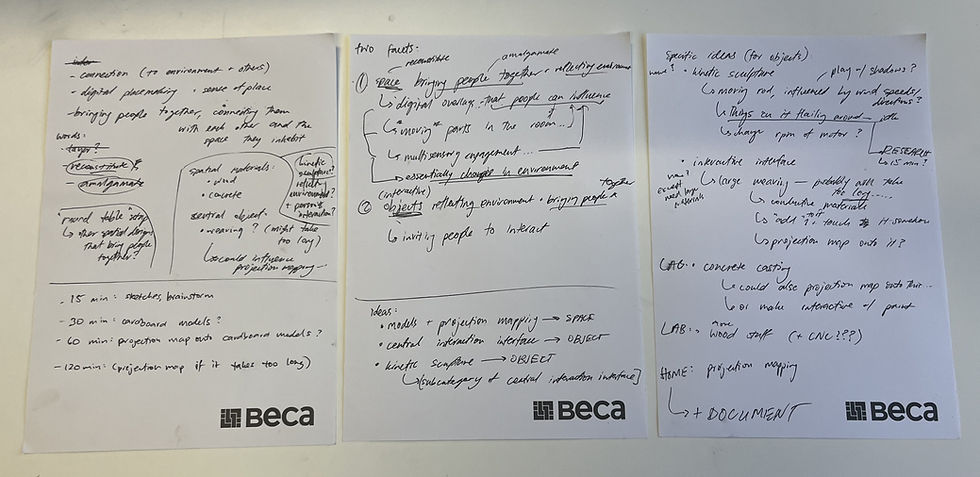
This ideation session helped me define which descriptive terms I wanted to choose:
Reconstitute: meaning to revitalise or refurbish; in this context, to revitalise under-utilised urban spaces that foster connection and community;
Amalgamate: meaning to combine into one structure; in this context, to bring people together and foster connection between them and their environment.
Process and Methods
4 x 15 minute artefacts: My first artefacts started somewhat accidentally: while on a walk on Stanmore Bay Beach, I realised how inspired I was by the different forms of nature that surrounded me. I began taking photos and internally generating ideas for how these natural forms could be incorporated in urban spaces to increase people's connection to such space. I noted three different features in particular: trees, waves/shoreline, and cliffs. Using photos of these features, I collated them into three separate pages that I then annotated with my reflections and ideas (Figures 2-4).
![Figure 2. Photo walk at Stanmore Bay Beach, capturing and annotating tree features [15 min].](https://static.wixstatic.com/media/5c8801_cc7d372b7b7346f28d159704d24bfcac~mv2.png/v1/fill/w_980,h_676,al_c,q_90,usm_0.66_1.00_0.01,enc_avif,quality_auto/5c8801_cc7d372b7b7346f28d159704d24bfcac~mv2.png)
![Figure 3. Photo walk at Stanmore Bay Beach, capturing and annotating wave and stone features [15 min].](https://static.wixstatic.com/media/5c8801_1925d16e23be438c8a1a54a56ad40a1d~mv2.png/v1/fill/w_980,h_691,al_c,q_90,usm_0.66_1.00_0.01,enc_avif,quality_auto/5c8801_1925d16e23be438c8a1a54a56ad40a1d~mv2.png)
![Figure 4. Photo walk at Stanmore Bay Beach, capturing and annotating cliff features [15 min].](https://static.wixstatic.com/media/5c8801_6078920dff8447af99862103873cf7b0~mv2.png/v1/fill/w_980,h_671,al_c,q_90,usm_0.66_1.00_0.01,enc_avif,quality_auto/5c8801_6078920dff8447af99862103873cf7b0~mv2.png)
Inspired by this exploration, I embarked on an intentional photo walk in the CBD area, taking photos of public spaces that seemed under-utilised or neglected. Similarly to the previous annotations, I collated these photos and wrote my notes about them on a sheet of paper (Figure 5). From these notes, I chose three spaces in particular to focus my making around:
the Jean Batten Place walkway,
the Ellen Melville Centre corner at Chancery Square,
the Kitchener Street side of the Auckland Art Gallery.
These spaces were chosen for their distinct spatial design constraints: Jean Batten Place features a long corridor with under-utilised benches, the Ellen Melville Centre corner is an awkward, unused space with low headroom due to the stairs, and the Kitchener Street side of the Auckland Art Gallery features a path that widens and narrows rapidly, meaning the rectangular shape formed against the wall of the building is not used at all by passersby.
![Figure 5. Photo walk around AUT city campus, Kitchener Street, High Street and Lorne Street, capturing and annotating under-utilised public spaces [15 min].](https://static.wixstatic.com/media/5c8801_6566a5bb41a948eca076ff2ce58d092e~mv2.png/v1/fill/w_980,h_689,al_c,q_90,usm_0.66_1.00_0.01,enc_avif,quality_auto/5c8801_6566a5bb41a948eca076ff2ce58d092e~mv2.png)
4 x 30 minute artefacts: To quickly generate spatial design ideas, I decided to create small-scale models using corrugated board and hot glue. Based on the locations chosen above and the inspirations I gleaned from Stanmore Bay, I created four separate models that addressed the design challenges posed by the spaces in different ways (Figures 6-9).
A common thread in my models was the idea of driving the flow of people in a space through placement of "obstacles" and through providing a natural path to follow. This is especially incorporated in Figure 6, inspired by wave and stone patterns on the beach and my experiences walking alongside the incoming waves and observing others doing the same. The incoming tides create a natural, intuitive path for people to follow, an idea I incorporated in this re-design through an engraved path mimicking the movement of waves. Similarly, I explored how obstacles could drive the flow of people in a space through sliding panels that could also be moved by passersby (Figure 9), helping to reinforce a connection with the space through providing the user with a method to directly and physically influence the space's design.
Another common feature in my models was the use of seating areas as an intuitive way to bring people together in urban space (incorporating the descriptive term amalgamate). These seating areas were often inspired by natural features I witnessed on the beach, such as stepping stones (Figure 6), layered cliff faces (Figure 7), and snaking tree branches (Figure 8). My hypothesis is that replicating the natural environment in an urban space may encourage emotional engagement with and connection to that space through providing familiar, non-urbanist features. However, this method might rely on users having pre-established connections with natural environments from which they can draw on when forming connections in these re-deisgned spaces. This feature is also designed to increase foot traffic and lingering time in these areas from passersby, helping to revitalise (or reconstitute) such spaces that were previously under-utilised.
![Figure 6. Corrugated board spatial re-design of the Jean Batten Place walkway inspired by wave and stone patterns on Stanmore Bay [30 min].](https://static.wixstatic.com/media/5c8801_22f5296042e14856a848aeae1c1b406b~mv2.png/v1/fill/w_980,h_336,al_c,q_85,usm_0.66_1.00_0.01,enc_avif,quality_auto/5c8801_22f5296042e14856a848aeae1c1b406b~mv2.png)
![Figure 7. Corrugated board spatial re-design of Ellen Melville Centre corner in Chancery Square inspired by cliff faces in Stanmore Bay [30 min].](https://static.wixstatic.com/media/5c8801_37ad427cb8b34b8ea1da8cddd6d94901~mv2.png/v1/fill/w_980,h_658,al_c,q_90,usm_0.66_1.00_0.01,enc_avif,quality_auto/5c8801_37ad427cb8b34b8ea1da8cddd6d94901~mv2.png)
![Figure 8. Corrugated board spatial re-design of the side of Auckland Art Gallery on Kitchener Street inspired by tree features in Stanmore Bay [30 min].](https://static.wixstatic.com/media/5c8801_a3716ea46041420dba55d73904eb0719~mv2.png/v1/fill/w_980,h_334,al_c,q_85,usm_0.66_1.00_0.01,enc_avif,quality_auto/5c8801_a3716ea46041420dba55d73904eb0719~mv2.png)
![Figure 9. Corrugated board spatial re-design of the Jean Batten Place walkway exploring flow of people in a space and personal connection through direct influence on the spatial design [30 min].](https://static.wixstatic.com/media/5c8801_a1b84f46e38848729697e14d20b2487a~mv2.png/v1/fill/w_980,h_238,al_c,q_85,usm_0.66_1.00_0.01,enc_avif,quality_auto/5c8801_a1b84f46e38848729697e14d20b2487a~mv2.png)
4 x 2 hour artefacts: My plan for the entire iterative making process this week was to do projection mapping on refined models of the ideas explored in the 30-minute artefacts. Given the time required for CAD modelling and physical construction of such models, I decided to complete these within the two-hour constraint, and complete the projection mapping of each one within the one-hour constraint.
I started by creating CAD models so that I could use these as a basis for the physical construction of said models using CNC and laser cutting machinery (Figure 10). I wanted to save the fourth two-hour artefact for an interactive object rather than a spatial design model, aligning with my intentions set out before beginning the making process, so I combined aspects of the models shown in Figures 8 and 9 into a single refined model, laser cut using MDF (Figure 11). These aspects included the moveable obstacles from Figure 9 and the spatial design and tree structures from Figure 8. The movable tree structures, made of waste 3D-printed tree supports, were particularly inspired by witnessing the tree forms on Stanmore Bay snaking underneath the sand and growing out of it, showing how a growing, alive form (the tree) can interact with an inanimate environment (the sand) and shape it to suit its needs. Similarly, passersby can move the tree structures along the paths and influence the otherwise inanimate environment, adapting it to suit their needs. This structure was also subconsciously influenced by children's toys in much the same way as last week's making, further incorporating a sense of play in the environment.

![Figure 11. Laser cut MDF model of spatial re-design of the side of Auckland Art Gallery, combining Figures 8 and 9 with elements of play embedded through interacting with moving tree sculptures, inspired by trees moving through inanimate sand in Stanmore Bay (modelled using waste 3D-printed tree supports) [2 hrs].](https://static.wixstatic.com/media/5c8801_326cc1b1178643ae90be82446169f9ae~mv2.png/v1/fill/w_980,h_691,al_c,q_90,usm_0.66_1.00_0.01,enc_avif,quality_auto/5c8801_326cc1b1178643ae90be82446169f9ae~mv2.png)
The other refined spatial design models were more faithful to their corrugated board counterparts. The cliff-inspired corner bench was also laser cut using MDF (Figure 12), while the beach-inspired walkway was cut out of plywood using a CNC router (Figure 13). A key difference between Figure 13 and Figure 6 was the slant added on the side of the wave pathway, mimicking the slant of a beach that guides people to walk closer along the incoming tide. The stepping stone seats were also grouped to provide more space to walk around (and for feasibility for cutting), and their heights varied to add a sort of "texture" to the architecture.
![Figure 12. Laser cut MDF model of spatial re-design of Ellen Melville Centre corner in Chancery Square [2 hrs].](https://static.wixstatic.com/media/5c8801_4998ffe87e1041edb41d298a8c9ac6a9~mv2.png/v1/fill/w_980,h_662,al_c,q_90,usm_0.66_1.00_0.01,enc_avif,quality_auto/5c8801_4998ffe87e1041edb41d298a8c9ac6a9~mv2.png)
![Figure 13. CNC plywood model of spatial re-design of the Jean Batten Place walkway [2 hrs].](https://static.wixstatic.com/media/5c8801_3833ea5e7b254444a166e4c0cc53d20e~mv2.png/v1/fill/w_980,h_314,al_c,q_85,usm_0.66_1.00_0.01,enc_avif,quality_auto/5c8801_3833ea5e7b254444a166e4c0cc53d20e~mv2.png)
For the final two-hour artefact, I wanted to revisit weaving and explore how it could act as a central object bringing people together. Using my findings from the previous week with incorporating conductive materials into fibre-based ones, and taking inspiration from a plain weave sample in the Rau Textiles Lab using hard materials such as bamboo, I cut sheets of copper metal and collected various scrap fabrics, yarns and offcuts to incorporate into a plain weave (Figure 14). Once again using a cardboard loom, I used twine for the warp and the gathered materials for the weft, weaving in the copper metal at various intervals so that it became part of the weaving product. The final weaving is shown in Figure 15. Although I didn't have time to incorporate interaction into the object, the copper metal could theoretically be soldered to wires and used as touch inputs, driving people to interact with the textiles and experience a more organic, familiar form of interaction.
Part of my motivation for choosing to do weaving as a central object bringing people together is inspired by its history: weaving as a practice was done as part of domestic labour tasks, most often by women, and would result in people coming together under a single roof to spin yarn, weave textiles and tell stories to pass the time (St. Clair, 2019). Not only was it a making practice, it was a narrative one with community and togetherness at its core. Weaving itself also depicts the idea of amalgamate: uniting different materials into one complete structure, much like communities weave together different identities, stories and histories (Why Is Storytelling and Ritual so Important?, n.d.). The weaving itself is also inherently connected to place: a single weaving is created in a particular place, using materials sourced from around it; in a similar vein, I have used materials situated in/around Auckland to create a weaving that I imagine could be placed in a public space and reflect this space it's situated within. Through interacting with the object, users could then form stronger connections with the wider space.

![Figure 15. Plain weave using copper metal sheets and scrap fabrics and yarns (woven fabric offcuts, hessian offcuts, Bremworth woollen spinning waste, donated yarns) from Rau Textiles Lab (weft) and twine (warp), woven on a cardboard loom [2 hrs].](https://static.wixstatic.com/media/5c8801_d47afc01d6354e82a9542f70f29259d7~mv2.png/v1/fill/w_980,h_1050,al_c,q_90,usm_0.66_1.00_0.01,enc_avif,quality_auto/5c8801_d47afc01d6354e82a9542f70f29259d7~mv2.png)
4 x 1 hour artefacts: As mentioned earlier, I set out to complete the two-hour models before the one-hour artefacts so that I could projection map onto them. Projection mapping is a skill I intend to use in my practice, especially in my final thesis exhibition, so I wanted to experiment with it first to teach myself a basic workflow. Using LumaMap, I configured the projected image to fit within the confines of the model being used. Since LumaMap can only apply one media file at a time, I created videos in TouchDesigner first that could then be exported and played in LumaMap.
Each of the three spatial design models' projection maps were influenced by the nature features the models were themselves inspired by. For example, in Figure 16, the CNC model of the walkway features ocean waves encroaching on the path set out for passersby to follow, whereas the stone seats are marked separately as "safe havens" in the ocean.
![Figure 16. Projection mapping setup using TouchDesigner and LumaMap with a Hitachi 3200 lumens projector (left) and projection mapping onto CNC model of spatial re-design of Jean Batten Place walkway (right) [1 hr].](https://static.wixstatic.com/media/5c8801_a5de7b7903664c5499d30c433349ef9c~mv2.png/v1/fill/w_980,h_346,al_c,q_85,usm_0.66_1.00_0.01,enc_avif,quality_auto/5c8801_a5de7b7903664c5499d30c433349ef9c~mv2.png)
The corner bench in Figure 17 features cliff photos taken at Stanmore Bay with an overlay of environmental data taken from the GeoNet Tilde API (GeoNet Tilde Time Series API, n.d.), specifically featuring crack displacement at a particular geological station, incorporating a temporal aspect to the installation that could provoke further engagement and interest from its users.
![Figure 17. Projection mapping onto laser cut refined model of spatial re-design of Ellen Melville Centre corner [1 hr].](https://static.wixstatic.com/media/5c8801_ca70d4f02fc646778f3e96ffea30be5d~mv2.png/v1/fill/w_980,h_451,al_c,q_90,usm_0.66_1.00_0.01,enc_avif,quality_auto/5c8801_ca70d4f02fc646778f3e96ffea30be5d~mv2.png)
The model in Figure 18 depicts a canopy of trees on its floor, along with a pulsing bloom pattern on the tree sculptures' paths. This pulsing piques curiosity in users and invites them to interact with and move the sculptures.
![Figure 18. Projection mapping onto laser cut refined model of spatial re-design of the side of Auckland Art Gallery on Kitchener Street [1 hr].](https://static.wixstatic.com/media/5c8801_f898b8f17ad1434bab291ba6e6c109f8~mv2.png/v1/fill/w_980,h_664,al_c,q_90,usm_0.66_1.00_0.01,enc_avif,quality_auto/5c8801_f898b8f17ad1434bab291ba6e6c109f8~mv2.png)
Finally, the weaving in Figure 19 lights up different sections of the weaving in a sinusoidal pattern that sequentially reveals the different materials and textures underneath, inviting users to inspect the object more closely and feel the difference in material texture firsthand.
![Figure 19. Projection mapping onto weaving using a sine wave pattern in TouchDesigner [1 hr].](https://static.wixstatic.com/media/5c8801_b22fe58a47834a53abe5e4990b68e847~mv2.png/v1/fill/w_980,h_1030,al_c,q_90,usm_0.66_1.00_0.01,enc_avif,quality_auto/5c8801_b22fe58a47834a53abe5e4990b68e847~mv2.png)
A video showcasing the different projection map tests is shown below (Figure 20).
200-Word Narrative (Used in Class)
The ingredients I have chosen are solid, processed and viscous, relating to my intention of exploring multidimensionality and tactility in interaction and manifesting in experiments with the materiality and shape of interaction interfaces. Viscous in particular also connects to my focus on urban public space, exploring how interactive installations can transform such spaces and drive the flow of people through a particular environment. Consequently, I chose the terms reconstitute and amalgamate: reconstitute meaning to revitalise under-utilised urban space, and amalgamate meaning to bring people together and encourage interconnectedness between them and their environment. Amalgamate also connects to my desire to merge multiple disciplines with my work, such as engineering and visual arts, and my use of both technology and traditional making in my practice reflects this intention.
My methods have included gathering environmental data such as sound recordings and photos that I then analysed through a self-ethnographic study of associated emotions and words. These words focused on visual and tactile language that then drove the design of further iterations. From there, I rapidly tested hypotheses through experiments with easily-sourced materials, such as cardboard, paper and fabric, before translating these into more refined models that focused on aesthetics and user experience.
Peer Feedback and Reflection
During the Peer Feedback session in Week 3, I displayed my work using a combination of pinned-up photo annotations, laying out my models on the table space, printing out my narrative for readability and showcasing the videos of my projection mapping tests (as there wasn't enough space and too much light to showcase the projection mapping directly). Elements of my exhibition are shown in Figures 21 and 22.
The types of peer feedback I received are as follows:
General positive, affirming feedback
Peers were particularly affirming of how I connected my design work to my research question
Peers had a great interest in the projection mapping medium and were appreciative of how I applied it to explore my research question
Peers generally were affirming of how I presented my work with the given space, especially with the video portrayal of the projection mapping tests which communicated a clearer sense of scale
Interest in further large-scale, detailed development of my work
Peer feedback emphasised a desire to see a further developed model of interaction in space,
A particularly insightful suggestion was to consider how the placement of this model in the intended public space would be useful to further explore how people would interact with it in that setting
Interest in incorporation of natural environments in urban spaces
Peers expressed great interest in this element of my work and how it could be developed further
Lack of focus with some wording of my research interests and design considerations
Peers pointed out that a "sense of play" may not be completely relevant to the rest of my research question
Peers also pointed out the need for more development of concept of "flow"
Recommendations for consideration of target audience
Peers suggested considering how my work might be communicated to a non-expert public, especially given the target audience of urban inhabitants
A particular suggestion was to have a simple 1-2 sentence explanation of my work
Reflecting on this feedback, I identified ways in which I plan to implement this feedback in the coming weeks:
I plan to develop a large, full-scale interactive piece, enabling me to properly test a detailed implementation of my ideas with audience interaction at the intended scale,
I will continue to explore the incorporation of the natural environment in my work, while also considering whether a user must have a pre-established connection to the natural environment to be able to connect to my work,
I will consider how I might narrow my scope to increase my research focus, focusing on keywords that connect with each other and have a driving force in my research aims,
I will develop strategies for communicating my work to non-expert audiences, and adopt a heuristic methodology within which to design more intuitive interaction that's accessible to a broad range of audience backgrounds.


Sources:
St. Clair, K. (2019). The golden thread: how fabric changed history (First American edition.). Liveright Publishing Corporation, a Division of W.W. Norton & Company.
GeoNet Tilde Time Series API. (n.d.). Retrieved 13 March 2026, from https://tilde.geonet.org.nz/ui/data-discovery
Video by Coverr on Pexels. (n.d.). Pexels. Retrieved 13 March 2026, from https://www.pexels.com/video/video-of-trees-from-below-853839/
Video by Damon Hall on Pexels. (n.d.). Pexels. Retrieved 13 March 2026, from https://www.pexels.com/video/waves-rushing-to-the-shore-1321208/
Why is storytelling and ritual so important? (n.d.). Together Culture CAMBRIDGE. Retrieved 11 March 2026, from https://www.togetherculture.com/blog/storytelling-and-rituals


Comments