week 3 - DP2

DESN801 // 12/05/26
Overview of Week 3 Progress
This week, I completed my Formative Presentation and reflected on the feedback I received, undertook more site analysis at Cruise Lane and completed a site visit at The Strand Station, examined shade maps at both of the above locations, completed physical experiments exploring concepts from my installation ideation of Cruise Lane, and reflected on the place-based narratives I had been developing for Cruise Lane and the methods I used to do so.
Table of Contents for this week's blog:
Reflection on Formative Presentation Feedback
Analysis of Sun Paths at Cruise Lane and The Strand Station
Physical Experiments
Site Analysis at The Strand Station
Revisiting Place-Based Narratives and Reflections on This Week's Progress
Reflection on Formative Presentation Feedback
During the Formative Presentation, I received the following feedback from the guest reviewers and instructors:
They suggested that Paul Dourish's embodied interaction may be a "red herring" given my focus on tangible interaction
I had felt similarly on this as well, as it was only tangentially related to tangible interaction, but aspects of embodied interaction and embodied knowledge may still be useful in my design endeavours.
Paul Dourish has also done other writing on related aspects to my research, such as sense of place, which I will aim to look into instead.
When completing site analysis, they suggested to look at people's movements and whether aspects of the site affect them consistently or not
I had begun to do this while looking at aspects of the alleyway such as the stairs from 41 Shortland Street down to the alleyway, as well as the sliding doors, and how this affected people's movements; I went back to my Week 2 blog and updated my analysis of these notes in light of this feedback.
They also suggested to consider environmental observations in the site, such as wind, sun paths / shadows, etc., and how such areas of shadow/darkness could be turned into areas of play
I didn't observe much wind in Cruise Lane, so my plan this week is to look into sun paths and shade maps and see how that changes the site at different times of day.
They were curious about the conceptual narratives I was bringing into the work, and whether I had settled on a particular theme
I had a few in mind but didn't make these explicit enough, so my goal this week is to begin identifying such themes and narratives with more clarity.
Another suggestion was to consider the duration of the work, and whether it resets, has an accumulative effect, changes over time, etc.
Because I'm coming from a non-design discipline, they recommended I keep in mind that designers learn from failure again and again, and to not be afraid of doing so
Finally, they gave recommendations for related works and ideas to look into:
Natural user interfaces (NUIs)
Two Tunnels between Bath and Bristol
Dark and scary pedestrian/cycling tunnels transformed into family-friendly areas with the help of interaction designers, eg. adding interactive lights and looking at the interaction between bike speeds and the loudness of sound
This week, in light of this feedback, I will aim to look into environmental factors of Cruise Lane such as sun paths and shade maps and make additional observations such as measurements and sound recordings to finish up my site analysis before doing the same for The Strand Station. I will also begin identifying place-based narratives more clearly to aid in my ideation and development of installation concepts.
Analysis of Sun Paths at Cruise Lane and The Strand Station
Using online websites such as ShadeMap and Alpenglow, I looked at the sun direction and shade maps of both Cruise Lane and The Strand Station at different times of day (both around the days I was visiting these sites, and at the opposite time of year to see how these changed under summer conditions). Screenshots of these shade maps are shown in Figures 1 and 2 below.

One observation from these shade maps is that there is almost always shadow present in Cruise Lane, with the exception of a small window of time close to midday where most or all of the alleyway is lit by the sun. This window, along with the amount of light present, seems to be greater in the summer compared to the current autumn/winter season. I found it interesting how there might be a small window of time where the whole alleyway is lit with sun, something that could be incorporated as a temporal element in an installation. I attempted to visit Cruise Lane at this exact time on May 7th, but cloudy conditions meant I was unable to observe this exact moment of sun across the alleyway's entirety. It's also possible that ShadeMaps may not be accounting for all of the surrounding buildings, and there might still be shadow present in the alleyway at all times of day at this time of year.

The Strand Station shade maps show an almost clock-like movement of rectangular shadow cast by the platform canopies, and how this direction of shadow changes in the summer months vs. the autumn/winter months. I found it interesting how this shadow affects the empty space between the platforms, leaving it well-lit at midday while casting it in shadow around sunrise and sunset, and changes what areas are lit at what times depending on the time of year. Overall, I found these naturally temporal elements of the sites fascinating and something that could be enacted upon with an interactive installation.
Cruise Lane Site Analysis Continued
As mentioned previously, I re-visited Cruise Lane on May 7th to see where the sun would align along the alleyway. Although the exact moment of alignment wasn't quite there either due to the clouds or shadows from nearby buildings, I did take photos of moments where the sun shone on parts of the alleyway and left interesting shadows, such as through the glass roof of the throughway in the middle (Figure 3).

I also took sound recordings on-site at four different locations: one at either end of the alleyway entrance, one at the throughway entrance in the centre of the alleyway, and one at a gated door inside the alleyway where water droplets were heard falling onto plastic on the ground. Taking these recordings allowed me to capture a different sensory element of the sight beyond visuals such as light, shadow and structures, helping to build up my phenomenological perspective of the site. These sound recordings can be found here: https://www.dropbox.com/scl/fo/d7oxnxbnz695fpblq8ja1/AO4hX9eGlTncFL0MJ9nDmJ0?rlkey=toskdfwhtiwuapwmaonn8bdes&st=vlmjej6b&dl=0
Spectrograms of these sound recordings can be seen in Figure 4 below, which show some steady background machinery noise in sections of the alleyway as well as lots of background noise at the Chancery St entrance due to construction and cars pulling in/out of the road. The Shortland St entrance also had consistent background noise due to machinery, but this wasn't picked up well in the recording due to windy conditions. The most intense noise seems to have been on the Chancery St side, decreasing along the alleyway towards Shortland St, which, alongside previous observations of construction and unpleasant smells at the Chancery St side, reinforces this stark difference between the two ends of the alleyway.

I also took measurements along the alleyway, walking down from Chancery to Shortland St, in case I wanted to use these in installation development or in creating a scale model:
Chancery St entrance width: 1.37m
1.29m width after granite section ends
Widens to 1.51m at first “bend”
1.31m width at pipe on left
1.0m width at little platform on left
Middle width (before throughway): 1.61m
Middle width (after throughway): 1.81m
2.2m width at edge of gate door
2.31m width after gate door
1.86m width after narrowing again
1.71m width before granite wall at Shortland St entrance
1.61m width at granite wall
1.68m width at Shortland St entrance
I found it interesting how these measurements show an "ebb and flow" of the widening and narrowing of the alleyway as you walk along it, and how these widths are affected by non-building elements such as pipes and small platforms placed along the ground of Cruise Lane, thereby reducing the "effective walking width" of the route.
Finally, I timed how long it took me to walk from one end of the alleyway to the other and back, walking at a fairly regularly pace (attempting to match that of people walking in the throughway), and found this to be exactly 60 seconds from either end.
Physical Experiments
This week, I also wanted to start physically experimenting with different materials and visuals based on the concepts I had begun ideating for Cruise Lane last week. Drawing on my key methodology of phenomenology in my research, as well as key concepts from Contextual Review, I wanted to specifically focus on experimenting with multisensory, atmospheric experiences engaging both central and peripheral perception (Pallasmaa, 2014). I also wanted to incorporate the idea of movement in these experiments, taking inspiration from the "ebb and flow" elements present in Cruise Lane (people moving through different areas of it, the widening and narrowing of the path, and the constant movement of light and shadows.
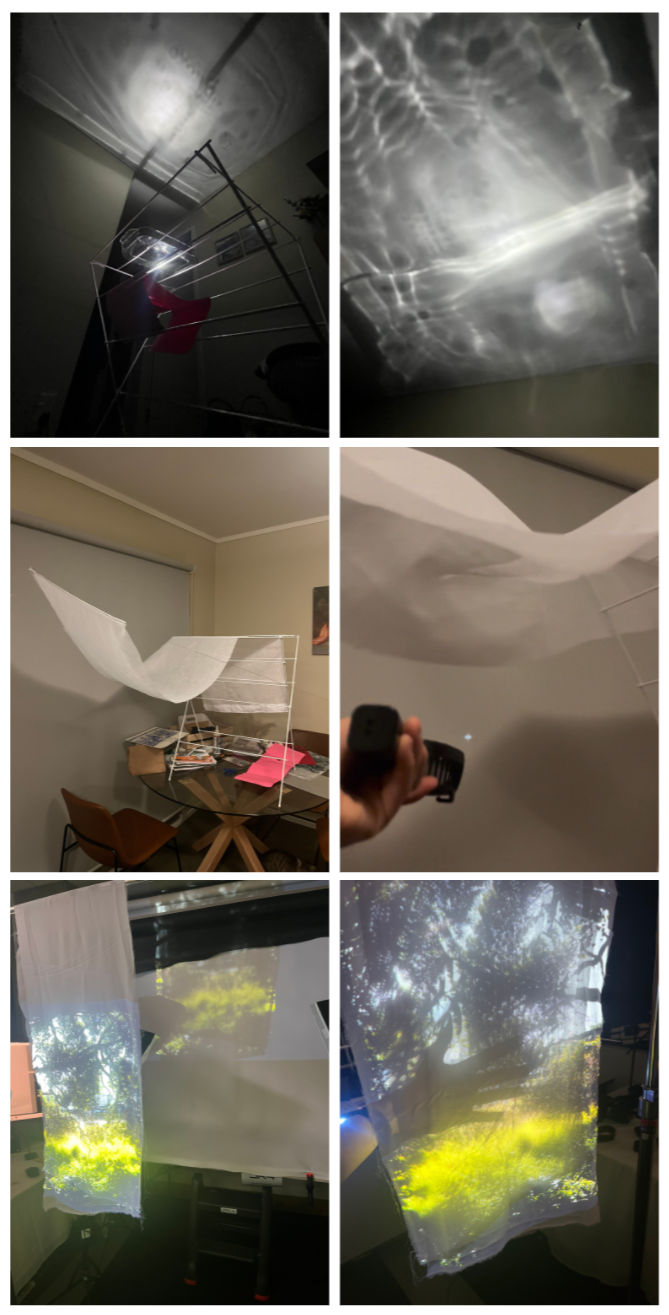
Building on ideas I had tested in Design Practice I with making intangible things (such as sound) tangible, I completed three physical experiments (Figure 5) by doing quick tests with materials found at home or with easily-accessed equipment. This method allowed me to rapidly test interactions with these materials and see what was interesting or feasible and could be developed further. These experiments were as follows:
Experimenting with caustics (making light refractions in water tangible),
Experimenting with wind-blown, moving fabric (making air movements tangible),
Experimenting with projection mapping onto different fabrics (continuing a previous design from DP1).
Videos and additional photos from these experiments can be found here: https://www.dropbox.com/scl/fo/m1zoa9xli75teilm90x2m/AGXHJ1anfhmsZDHNUE4lfiU?rlkey=vm3o7o16n717nav2xnwj3jry5&st=6y43rx28&dl=0
I found that different interactions could be triggered through movement such as disturbing the water in the caustics experiment (either by moving the tray of water, blowing the water around with air, or adding droplets to it), moving the fan blowing air onto the fabric in the wind-blown fabric experiment, or moving one's body behind the fabric in the projection mapping experiment to cast different shadows. I also found it interesting how these interactions transformed the materials and elements being used, not only making aspects like light or moving air tangible, but also making "inorganic" elements such as fabric feel more organic and alive. In the case of the caustics experiment, I also appreciated the atmospheric element of the light dancing around nearby walls and ceiling, engaging both central and peripheral vision and encouraging more head movement to look around at the different patterns. Analysing these interactions from this phenomenological, first-person perspective has helped me to consider how other users might engage with them (such as by looking in different directions, or perhaps reaching out to touch the different materials involved).
However, I also observed many feasibility challenges with these experiments being implemented as installations: the caustics and projection mapping effects rely on dark external lighting conditions to be clearly visible, meaning they may not be suited for the alleyway unless only implemented at night (given the shade maps show sections of the alleyway are lit during the day). Using fabric may also be difficult given the alleyway's exterior environment, offering little shelter from rain if it were to fall. As a result, these exact materials may not be suitable for this location, but I could still draw from the interactions and sensory engagement opportunities they present for other installation ideas.
Site Analysis at The Strand Station
On May 6th, I was given the opportunity to conduct a supervised site visit with KiwiRail at the disused platforms behind The Strand Station for approximately an hour (around 1-2pm). I was given permission to take photos (Figures 6 and 7), sound recordings and observations of the site which I've included below. I'm incredibly grateful to KiwiRail for this opportunity and want to thank them for arranging this and accompanying me for the site visit!


Other site photos can be found here: https://www.dropbox.com/scl/fo/j82bcbbfgmd3wju3z5jef/ANplkgoBSQqB1MBSbdb-JPw?rlkey=pbnb50itq1isgpa2ki3ght6zj&st=gue196b2&dl=0
The sound recording I took can be found here: https://www.dropbox.com/scl/fi/e4liumcu3nokvp5xmqas4/The-Strand-Station-05-06-26-1-51pm.m4a?rlkey=770vjytr1iysp0xdwgrf6i1sf&st=wgsx7hyp&dl=0
A spectrogram of the above sound recording is shown below (Figure 8):

The sound recording and spectrogram shows background noise from the nearby port of Mechanics Bay, as well as birdsong in the trees onsite (between 23-26 seconds of the recording).
Measurements of the canopies during this site visit:
Approx 8 metres length between columns
Approx 2.4 metres tall from ground to shortest part of canopy overhang on longer stretch of platforms (south side)
Slightly taller to shortest part of overhang on shorter stretch of platforms (north side)
Approx 2.7-2.8 metres to higher part of overhang
Columns are approx 0.4 by 0.5 metres width/length
Double columns are about 1 metre length apart
Approx 2.7-2.8 metres to the edge of the platform from the column
Other notes from this site visit:
Left side platforms (shorter stretch, north side):
Dual column arrangement for more width of platform overhang
Left side platforms have a lot of overgrowth with vines/ivy from the nearby trees
All shade underneath them (between 1-2pm)
Nearby trees seem to stretch over the platforms
Birds (including Tūī) heard in the trees and possibly above the platform canopies
Shadow and light patterns seen on ground from nearby trees
Lots of moss on this side
Right side platforms (longer stretch, south side):
Single column arrangement, less platform width
Most of it underneath was in sun (between 1-2pm)
Crumbling pieces from the canopy seen on the ground, exposed rebar in the concrete above
Plants seem to be growing on the roof (on both canopies)
Rubbish cans still present on the platform (a bit of trash in one of them)
Drier plants on this side, less plants in general
Random items hanging from platforms (string, small bits of metal)
Graffiti limited to columns and ends of canopies (not the inside roof)
Native plants identified:
Non-native plants identified:
I also took a photogrammetry scan of a canopy column on the south side platform using Polycam (Figure 9): https://poly.cam/capture/46BC41CA-A57F-4D84-BC12-6CAD339AFC29

During the site visit, I asked the KiwiRail employees who had accompanied me about the trees planted behind the north side platform. They were able to get me in touch with Rail Heritage Trust members who shared that the trees were planted around the opening of the Railway Station in 1930 as a "beautification" strategy to encourage more railway use as it was seeing a decline at the time.
Looking back on my photos and notes, I found the difference between the two platforms quite interesting in how they "section off" aspects of the site and almost create a "performance stage" setup, where looking across from one platform allows observation of the other. I also found the decay present in the site, indicative of its status as a residual space, fascinating: the crumbling platforms, plant overgrowth, and leftover artefacts showed evidence of previous use but poor present-day maintenance. Although I'm unable to observe people's movements in the site nowadays, I'm able to trace back prior movements through walking in the site myself, noting aspects such as small ramps that lead from the platforms to the concrete section below (what I later realised was a railway section that was transformed into a road around the 1970s as a sort of drop-off zone) where people might ascend or descend from the platform with bags. I especially loved walking through the north side platform which offered shade from the sun overhead while still allowing dappled light to shine through the trees onto the ground, and which featured trees and nature nearby with birdsong heard overhead. Various trains would also move past on the nearby tracks, making the space feel constantly surrounded by energy and movement. Views of the city were also spectactular, the Sky Tower perfectly centred between the two platforms. One of the KiwiRail employees accompanying me commented that they would "love to have a picnic there", showing interest aside from my own in transforming this space to one that could be of public use and enjoyment.
Revisiting Place-Based Narratives and Reflections on This Week's Progress
This week, based on feedback from the Formative Presentation, I wanted to finish up my site analysis by re-visiting the narratives I had identified for Cruise Lane and identifying ones for The Strand Station. I realised much of the background research I had done was very historic-focused, and some of the narratives I had picked for Cruise Lane was centred around this (such as connecting people with past building materials like raupō, or with the alleyway as a transition from land to sea at the original shoreline of Shortland St). I initially was thinking of identifying themes for The Strand Station that was equally centred around historic information, such as ticket machines and hole punches or the structure of the canopies themselves. I realised through this that I was subconsciously leaning towards almost creating a museum space, rather than a living space that people could inhabit and linger in and that would serve people in the present.
Around this time, I also had a conversation with the company Fresh Concept which has completed many placemaking projects around Auckland. I gained two insights in particular from this conversation:
The idea of using a historical narrative to imagine what a space could be, and
Considering the design of spaces not from a bird's eye view (as is often the case in urban environments), but from the perspective of someone inhabiting the space.
This second point aligns with my shift in site analysis methods, from background research to a more phenomenological, first-person perspective of the site, but also has implications for my installation design methods further down the road.
These insights were important in pushing me to consider both examining sites and designing spaces with the present and future user in mind, rather than a past user, but still drawing from this historical knowledge to help shape what these spaces could be. Through this realisation, I also decided to draw more on abstract observations such as movement/embodiment in space, the tangibility of a space (through materials, structures, etc.), and more intangible elements of space (such as light and shadow). I realised I will need to adjust my methods of ideation and theme brainstorming from last week's, as those sketching methods were limited in focusing on generating very literal input and output concepts rather than considering the more abstract elements mentioned above.
Through completing site analysis in both Cruise Lane and The Strand Station now, I feel that The Strand Station is more appropriate for my research through better embodying the idea of a "residual space" and offers more potential for transformation with lingering in mind. Cruise Lane, as a regularly used throughway, doesn't necessarily exist as a residual space, and interventions there may disrupt the flow of people in the space. The site also presents significant feasibility concerns for implementing technological installations there, making it difficult to ideate concepts that would work in practice. As I've been completing analysis of two sites simultaneously instead of one, my timeline and scope for this project will also have to be updated to be more achievable in the remaining timeframe.
My goals for next week are as follows:
Adjust my methods of brainstorming place-based narratives for The Strand Station, focusing on more abstract concepts and considering the site from a first-person perspective of a potential present-day user
Methods such as sketching onto photographs of the site, mindmapping around different concepts or ideas, etc.
Making a scale model of The Strand Station using the measurements and photogrammetry scan I obtained during the site visit
This will help to visualise the site and its scale, given I cannot visit it repeatedly, and could be used to develop installation prototypes as well.
References:
Alpenglow. (n.d.). Sun direction calculator: Sun position. Retrieved June 4, 2026, from https://alpenglowapp.com/sun-direction-calculator/-36.8472,174.7675
Pallasmaa, J. (2014). Space, place, and atmosphere: Peripheral perception in existential experience. In C. Borch (Ed.), Architectural atmospheres (pp. 18–41). Birkhäuser.
Polycam. (n.d.). Polycam (3D capture app) [Computer software]. https://poly.cam/
ShadeMap. (n.d.). [Interactive sun and shadow map of Auckland, New Zealand]. Retrieved May 24, 2026, from https://shademap.app/@-36.84714,174.76696,17.75113z,1798492492354t,0b,0p,0m


Comments