w1 - raiding the pantry

Updated: Apr 11
DESN800 // 03/03/26
Research Question and Ingredient Analysis
My research question from my initial proposal is how the creative use of interactive technology can enable the transformation of under-utilised public spaces, such as waiting or transition areas in buildings, to encourage emotional engagement in urban environments. Since writing this question, my focus has narrowed to creating interactive installations in particular, but my focus otherwise is quite broad so that I can incorporate findings from iterative making in this semester. The idea of emotional engagement specifically as my "why" may change, but I am generally interested in exploring how we can utilise interactive installations to encourage a better sense of community, identity and connectedness in urban environments. Thus, two disciplinary facets of my question exist: interaction design of the installation, and spatial design of the space it's situated within and how this connects to the broader urban environment.
In light of this reflection, I decided to approach this week's making from two angles:
Exploring a more "intangible" aspect of urban environments (sound) and how it could be translated in more tangible ways through emotional association and engagement of senses (sight, touch),
Exploring materiality of interaction interfaces through touch and object/material associations, using conductive materials to create various capacitive touch sensors, as a rejection of typical flat, smooth, 2-dimensional touch interfaces (this rejection is explained further through discussion of my methods).
When analysing the ingredients through the lens of what I would be making, I gravitated towards solid, processed and viscous.
Solid was chosen because of the multidimensional realm a "solid" object exists in, connecting to ideas of physicality and materiality and providing a framework within which I could explore translating intangible concepts into tangible and interactive ones.
Processed relates to both transforming materials into different forms such that they could be interacted with, and to transforming intangible concepts into tangible ones. I believe interactive installations are inherently "processed" views of the spaces and/or concepts they reflect because they translate such ideas into different media (visuals, sound, textures, etc.) that users can understand and communicate with.
Viscous was a word that stood out to me for its ties to my wider research interests, particularly how interactive installations can influence, or be influenced by, the flow of people in a public space (Brignull & Rogers, 2003). Given I had chosen not to pursue a direct spatial design approach this week to limit my scope, I instead let this word influence some of my visual language in my making.
Process and Methods Used
Exporing Representation of Environmental Data
The first angle, involving translating an intangible aspect of urban environments into something tangible, first started with collecting environmental data with which to transform in further iterations. I chose to focus on sound because I usually create and design with lighting and visuals, so I wanted to push myself with a medium I was less familiar with.
Using a Zoom H4n sound recorder, I walked around the AUT city campus and down to Queen Street, taking several sound recording samples at various road intersections. I chose to contrast these louder urban environments with sound recordings taken in Albert Park, the closest green space to the university. My hypothesis was that the sound intensity would differ greatly in these two regions which I could translate into visual and tactile media.
Listening back to the recordings, I reflected on emotional associations with sounds in different environments, tying these words to visual and tactile experiences, through the following questions and responses:
How do loud dissonant sounds, such as those in urban spaces, FEEL?
emotions: disruptive, opressive, suffocating, grating, angry
tactile: rough, hard, sharp
visual: red, bold, striking, clashing, harsh lines/edges
How do quiet consonant sounds, such as those in green spaces, FEEL?
emotions: soothing, calming, peaceful
tactile: soft, smooth, rounded
visual: pastel/muted, complementary, soft lines/shapes
5 x 5 minute artefacts: Using MATLAB, I converted the sound recordings into waveform graphs (amplitude, or sound intensity, versus time) and spectrograms (frequency versus time, with colour indicating the intensity of sound) (Figure 1).
A notable observation from these graphs was the visual inconsistencies present in the spectrograms from louder environments (indicative of sudden higher frequency sounds), as opposed to the very consistent colours and patterns in the spectrogram from Albert Park. These inconsistencies provided confirmation for my emotional response to loud sounds, particularly in how they are disruptive, and added a further dimension to explore through visual and tactile transformations.
![Figure 1. Waveform and spectrograms exported from Matlab code (pictured top right) with locations where sound recordings were taken [5 min].](https://static.wixstatic.com/media/5c8801_23e630a6663540bba0d90e761ae6ac70~mv2.png/v1/fill/w_980,h_994,al_c,q_90,usm_0.66_1.00_0.01,enc_avif,quality_auto/5c8801_23e630a6663540bba0d90e761ae6ac70~mv2.png)
6 x 10 minute artefacts: I felt that the graphs alone, when presented to a non-technical audience, may not effectively communicate the different environments they were based on. Using my word brainstorm, I chose key colours and textures to transform the graphs with using Photoshop (Figure 2): I gave the louder environment spectrograms stark, contrasting reds and blacks, highlighting those inconsistencies even further and creating a rough, grating visual texture in the image; the quieter environment spectrograms were assigned muted, serene blues and purples and even a bit of Gaussian blur. This practice was especially influenced by my choice of the ingredient processed, where I took a more raw representation of the sound recording and processed it into something capable of being more universally understood. The overall layout of my sound recording graphs and visual manipulations are shown in Figure 3.
![Figure 2. Spectrograms manipulated in Photoshop [10 min].](https://static.wixstatic.com/media/5c8801_8a40f41f5d314d4ea63746ba34589051~mv2.png/v1/fill/w_980,h_443,al_c,q_90,usm_0.66_1.00_0.01,enc_avif,quality_auto/5c8801_8a40f41f5d314d4ea63746ba34589051~mv2.png)
![Figure 3. Layout of original and manipulated sound recording graphs and screenshot of MATLAB code used to generate spectrograms [5-10 min].](https://static.wixstatic.com/media/5c8801_48344cb521f14fcb98c9debf759170cb~mv2.png/v1/fill/w_980,h_834,al_c,q_90,usm_0.66_1.00_0.01,enc_avif,quality_auto/5c8801_48344cb521f14fcb98c9debf759170cb~mv2.png)
12 x 15 minute artefacts: To experiment with a tactile representation of these sound environments, embodying the ingredient solid, I chose to explore laser cutting and raster engraving with MDF and acrylic. I was familiar with laser cutting to create cut-out shapes, but not to engrave images. Using the manipulated spectrograms from the 10-minute artefacts, I experimented with power and speed laser cutter settings to achieve different visual contrasts and tactile textures in the engravings and cuts. For example, I intentionally created a rougher finish on an iteration of a louder environment spectrogram to contrast with the smooth finish of the quieter one.
I also used material to represent these different environments: roughly engraved and cut MDF for the louder ones, and smooth acrylic for the quieter ones. When piecing together these cut pieces, I noticed that I could create a cityscape-like visual through layering parts of the cut-out spectrogram, further emphasising their urban origins. Process photos are shown in Figure 4 and the final artefacts are shown in Figure 5. Some of my other cut pieces were incorporated into my experiments with interactive interfaces, detailed below.

![Figure 5. Laser cut spectrograms and waveforms, experimenting with material and laser cut power and speed settings to achieve different textures [15 min]; embroidery thread woven into laser cut spectrogram [30 min].](https://static.wixstatic.com/media/5c8801_45e1f5566f044350b600c43b653e6342~mv2.png/v1/fill/w_900,h_1198,al_c,q_90,enc_avif,quality_auto/5c8801_45e1f5566f044350b600c43b653e6342~mv2.png)
3 x 30 minute artefacts: One of my 30-minute artefacts was formed using a spare laser cut spectrogram piece, overlaying key peaks in the graph with embroidery thread stitched into the wood (Figure 5). This artefact was my first attempt at incorporating softer materials into my work, which I then further explored with weaving.
Using a makeshift cardboard loom (Kate, 2016), I took snippets of the manipulated spectrograms and represented them with small plain weave pieces, allowing for both a tactile and visual experience of each sound (Figure 6). I had never done weaving before but have always been interested in the practice given my background in various knitting, cross stitch and community-based quilting projects, so I immensely enjoyed adding this skill to my repertoire. This practice also forced me to focus on a very specific aspect of each image to feasibly translate it into weaving in a short amount of time, enabling me to pick aspects of each image that I felt best represented the larger whole. For example, I used a notable feature in the louder environment spectrogram to depict the inconsistent and striking nature of the sound.
![Figure 6. Manipulated spectrograms translated into weavings with a cardboard loom (pictured right) [30 min].](https://static.wixstatic.com/media/5c8801_8deb1f0f6b7245ee8e9d8de415b40214~mv2.png/v1/fill/w_980,h_456,al_c,q_90,usm_0.66_1.00_0.01,enc_avif,quality_auto/5c8801_8deb1f0f6b7245ee8e9d8de415b40214~mv2.png)
Exploring Interaction Interfaces
7 x 5 minute artefacts: For the second angle, I started by noting observations of existing interactive interfaces using sketches and words (Figure 7), with four main focuses:
(Existing) Physical Interactive Interfaces
Organic Shapes + Feelings (influenced by the word "viscous")
Interactives Embedded in Space
(New) Physical Interactive Interfaces (based on the above brainstorms)
From this brainstorm, I noted the usual cold, hard, 2-dimensional surfaces used for interaction such as touchscreens, buttons, handles, etc. which led to questioning whether more organic, textural, flexible attributes could be incorporated into interactive surfaces. This inquiry was largely influenced by the word viscous, bringing to mind ideas of organic, fluid shapes and movements (eg. of fibres). Through this reflection, I realised I wanted to employ organic shapes and materials to reject typical interaction interfaces that use smooth, hard surfaces that suit mass-manufacturing and distribution, especially to explore whether this would elicit different responses from users interacting with the interfaces.
![Figure 7. Brainstorming sketches and word associations of existing physical interactive interfaces, organic shapes and feelings (aligning with "viscous"), interactives embedded in space, and ideas for new physical interactive interfaces given the previous brainstorming sessions [5 min].](https://static.wixstatic.com/media/5c8801_021dee5c6b554667af9b3a79f0312f59~mv2.png/v1/fill/w_980,h_662,al_c,q_90,usm_0.66_1.00_0.01,enc_avif,quality_auto/5c8801_021dee5c6b554667af9b3a79f0312f59~mv2.png)
Based on this initial brainstorm, I rapidly experimented with three different conductive materials (chosen for their potential use as touch sensors): conductive paint, copper tape and metal memory wire (Figure 8). My exploration involved playing with shape, form and texture, such as by poking holes through the copper tape to create a rougher texture on some inputs.
![Figure 8. Experimentation with conductive materials: conductive paint in organic shapes, copper tape on paper with holes punched for roughness, metal memory wire [5 min].](https://static.wixstatic.com/media/5c8801_b70c25adf22e4fbe9b11ee72307e3a31~mv2.png/v1/fill/w_980,h_222,al_c,q_85,usm_0.66_1.00_0.01,enc_avif,quality_auto/5c8801_b70c25adf22e4fbe9b11ee72307e3a31~mv2.png)
6 x 10 minute artefacts: Continuing from my initial play with conductive materials, I expanded to use conductive thread in cross stitch, resistors connected to metal wire to create a sort of conductive jewelry artefact, and electrical wire crocheted into a chain (Figure 9). I iterated upon the copper tape touch interface with a cleaner form, and experimented with more recognisable forms using the metal memory wire. I enjoyed incorporating more traditional practices such as cross stitch and crochet, practices that in many ways led to the development of the first machines and thus modern technology as we know it. Initial tests like these would further inspire me to increasingly incorporate these traditional ways of making in my practice as a way of exploring different modes of technology and what they represent in space, community and identity.
![Figure 9. Experimentation with conductive materials: metal memory wire, resistors, cross stitch with conductive thread, crochet with electrical wire, copper tape on paper [10 min].](https://static.wixstatic.com/media/5c8801_183028a5421f468188c2a1fd9df356e1~mv2.png/v1/fill/w_980,h_445,al_c,q_90,usm_0.66_1.00_0.01,enc_avif,quality_auto/5c8801_183028a5421f468188c2a1fd9df356e1~mv2.png)
Additionally, as mentioned above, I used some of the laser cut pieces to turn into touch interfaces, such as by painting them with conductive paint or covering the rough cut surface with copper tape. This making helped me further experiment with texture and material in touch interfaces.
9 x 30 minute artefacts: To expand my skills and trial new methods, I decided to try woodworking (I felt this would be an especially useful skill if I wanted to make structural pieces for installations further down the line). I used the band saw to cut different shapes out of plywood, again focusing on organic, imprecise forms (Figure 10). During this process, I realised I was subconsciously inspired by children's toys and thus incorporating a sense of play in interaction, especially as most interactive installations are present in children's educational exhibits but seem to disappear as children get older. The idea of textural interaction seems especially emphasised in children's learning, where young kids are encouraged to feel different materials to learn about their world.
My focus then shifted towards turning these cut blocks into interactive buttons through 3D-printing a part that could interface the blocks with a spare keyboard key cap I had (Figure 10). From there, I added various fabrics over the surfaces of some of the blocks and laser cut one of the blocks with increasing roughness to incorporate different textures into the interactive interfaces (Figure 11). Finally, influenced by an early artefact, I painted one of the blocks with different fluid shapes in conductive paint to create an array of touch surfaces, and wrapped another shape in metal memory wire (Figure 12).

![Figure 11. Organic wooden shapes covered in different fabrics with 3D-printed keyboard button inserts [30 min].](https://static.wixstatic.com/media/5c8801_9b1536a3a9fd485db279968e9c899db3~mv2.png/v1/fill/w_980,h_224,al_c,q_85,usm_0.66_1.00_0.01,enc_avif,quality_auto/5c8801_9b1536a3a9fd485db279968e9c899db3~mv2.png)
For my last 30-minute artefacts, I went back to softer materials and traditional fibre-based practices: I crocheted a swatch which I then weaved copper tape through, knit an i-cord with conductive thread, and cross-stitched a more refined "button" with the same conductive thread (Figure 12). These softer materials incorporated ideas of flexibility and familiarity in the touch interfaces through mimicking clothing and other textiles; the concept of familiarity in interaction (such as with the object being interacted with, and/or the technology used to drive the interaction that the user must have a prior understanding of) is another aspect I am interested in from a research standpoint (Beale et al., 2022), and I found it interesting to observe how familiarity can be incorporated through form, function and material.
![Figure 12. Crochet with interwoven copper tape, knitting with conductive thread, cross stitch with conductive thread, organic wooden shape covered in metal memory wire, laser cut organic wooden shape with increasing roughness painted in conductive paint [30 min].](https://static.wixstatic.com/media/5c8801_7ff47f8ab57c407cabe77e3df7f22396~mv2.png/v1/fill/w_980,h_667,al_c,q_90,usm_0.66_1.00_0.01,enc_avif,quality_auto/5c8801_7ff47f8ab57c407cabe77e3df7f22396~mv2.png)
3 x 1 hour artefacts: For my final three artefacts, I wanted to demonstrate the potential of interaction with the different materials, forms and methods I had experimented with thus far.
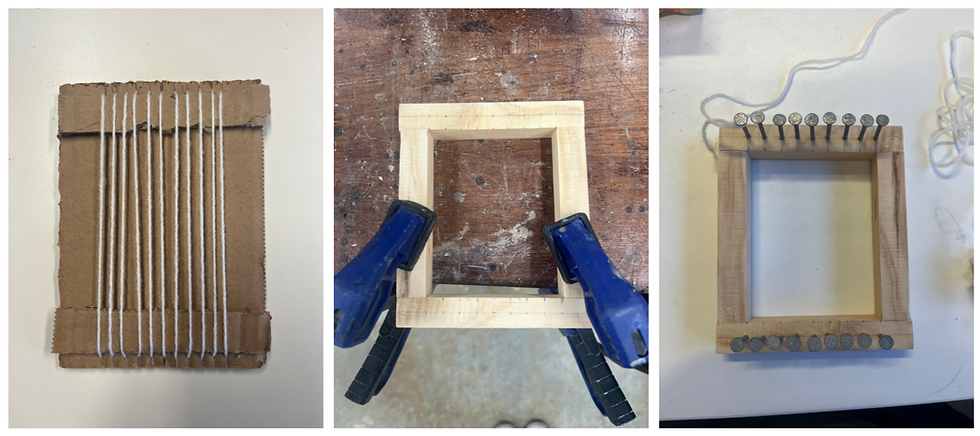
The first artefact incorporated my trials with weaving and using copper tape embedded in textiles. I created a wooden frame and turned this into a loom (Figure 13) for a plain weave using white yarn for both warp and weft. I then wove copper tape through the weaving and taped this to a jumper cable connected to an ESP32 microcontroller through a breadboard (Figure 14). Using a blue LED, I transformed the weaving into a touch interface so that when a finger touches the copper tape in the weaving, the LED turns on. On a technical level, this wasn't the most effective method as the copper tape had poor conductivity and often didn't work when touched, but I enjoyed combining my iterative making learnings and adding softness into a touch interface with this artefact nonetheless.
![Figure 14. Wooden frame and weaving with interwoven copper tape, forming a conductive interface to turn on a blue LED using an ESP32 microcontroller [1 hr].](https://static.wixstatic.com/media/5c8801_21e82233a05a4aa1bf4309c351849424~mv2.png/v1/fill/w_980,h_334,al_c,q_85,usm_0.66_1.00_0.01,enc_avif,quality_auto/5c8801_21e82233a05a4aa1bf4309c351849424~mv2.png)
The second artefact used the metal memory wire forms I had experimented with earlier, turning them into a conductive flower garden using lights at each flower's centre that would illuminate when the respective flower was touched (Figure 15). With this artefact, I incorporated my experimentations with the form of the touch interface, creating something organic and familiar with which users could interact. Similar to the first artefact, an ESP32 microcontroller was used to receive capacitive data from each flower and send a signal to each light based on whether the flowers were touched.
![Figure 15. Flowers formed from metal memory wire with lights embedded at their centres; ESP32 microcontroller used to create conductive interface from flower; touching each flower turns on the respective light [1 hr].](https://static.wixstatic.com/media/5c8801_f6fa4057f4114fab9b20eb8516f55590~mv2.png/v1/fill/w_980,h_441,al_c,q_90,usm_0.66_1.00_0.01,enc_avif,quality_auto/5c8801_f6fa4057f4114fab9b20eb8516f55590~mv2.png)
The third and final artefact built off of my experimentations with wooden organic forms: I created a pinch block with wood covered in copper tape, thus forming different touch points (Figure 16). Again, using an ESP32, I translated the touch inputs into output signals, this time to an RGB LED where each red, green and blue channel was tied to each touch input. Through this setup, the artefact became a colour mixer, where multidimensional finger movements could result in different colour outputs.
![Figure 16. Pinch block interactive interface using organic wooden shape covered in copper tape; each touch interface controls either the red, green or blue channel in an RGB LED using an ESP32 microcontroller [1 hr].](https://static.wixstatic.com/media/5c8801_fb8bee20e75d477ca0e82a724eb6f00d~mv2.png/v1/fill/w_980,h_664,al_c,q_90,usm_0.66_1.00_0.01,enc_avif,quality_auto/5c8801_fb8bee20e75d477ca0e82a724eb6f00d~mv2.png)
Summary of methods used:
Brainstorming through sketches and writing down words, often in a self-ethnographic way through evaluating my own observations and feelings associated with different visuals, sounds and materials (touch),
Collecting environmental data ("site visits") in the form of sound recordings,
Employing software (MATLAB, Photoshop, Illustrator) to process sound recordings into different visual media (graphs, laser cut files),
Machinery (laser cutter, band saw) to process wood and acrylic into different forms,
Fibre-based manual making (sewing, crocheting, knitting, cross stitch, weaving) to process textiles with conductive materials.
What Worked and What Didn't
What worked: I immensely enjoyed the natural progression of brainstorming and iterative making using different conductive materials, or starting with sound recordings and using these as a basis for further experimentation, and seeing inspiration take hold based on expected or unexpected findings from these early iterations. The early experimentations allowed me to trial new methods without a focus on achieving complete functionality or success, enabling me to reflect on what worked and what didn't, and what I felt drawn towards and would like to incorporate in further making.
What didn't work: Given the time constraints and the relatively inexpensive materials I was confined to working with, I came across many technical issues that prevented me from achieving the results I often set out to attain. For example, attaching wires to copper tape for the final artefacts was very difficult to do and led to a poor interaction experience where my peers found it wouldn't work. While somewhat disappointing, I was still able to find successes in these artefacts that could influence my practice elsewhere. Additionally I felt my dual approach to this assignment was perhaps a bit disjoined and led to some sporadic, unfocused making. Moving forward, as the number of artefacts decreases, I plan to be more intentional with what I make so that it better aligns with my initial research question.
What I Learnt Working with Time and Scale Constraints
The time and scale constraints had the positive effect of reducing the pressure to produce something of high quality, taking any fear or immobilisation out of the making process. This drove me to try new techniques, workshops and materials more, even with the limited time. The scale constraints also meant I could carry out very focused tests with specific materials/forms and not get lost in the overarching goal or aesthetic.
However, in relation to my practice, I felt the time and scale constraints restricted what I could make: I wanted to try more spatial design and installation-focused works, but felt the time and space required for this were out of scope for this week's work. I plan to make this more of a focus moving forward as we begin to create bigger artefacts with more time.
Finally, I felt that the constraints led to a struggle to generate ideas in order to meet the quota of 51 artefacts. I often struggled especially with the last 2-3 items in each time bracket, and this led to excess time taken to generate new ideas or gather necessary materials together. Sometimes this had the positive impact of driving me to try new things and spark new ideas, but other times I felt like I was coming up with different ideas just to tick a box. Even so, I was glad for the opportunity to exhaust all possible outcomes of the materials and methods I was trialling with each new iteration.
Reflection and Short Narrative
Overall, I am incredibly proud of the variety of methods I employed and the ways I documented them for this week's making. Using the ingredients of solid, processed and viscous, I explored different forms, materials, textures and visual representations of environmental data and interactive interfaces. These outputs (Figures 17 and 18) connect back to my research question of exploring how interactive installations in public space can encourage emotional engagement between people and their environment: through communicating environmental, place-specific data such as sound in ways that are tangible and connected to emotion, and through offering interaction solutions that are organic and familiar, users may feel a stronger emotional link to the places they are situated within that the installation is portraying.
![Figure 17. Layout of artefacts on desk [5 min - 1 hr].](https://static.wixstatic.com/media/5c8801_1178a631fcc244878367eb5a8e96f1dc~mv2.jpg/v1/fill/w_980,h_602,al_c,q_85,usm_0.66_1.00_0.01,enc_avif,quality_auto/5c8801_1178a631fcc244878367eb5a8e96f1dc~mv2.jpg)

Sources
Beale, G., Smith, N., Wilkins, T., Schofield, G., Hook, J., & Masinton, A. (2022). Digital Creativity and the Regional Museum: Experimental Collaboration at the Convergence of Immersive Media and Exhibition Design. J. Comput. Cult. Herit., 15(4), 78:1-78:23. https://doi.org/10.1145/3527620
Brignull, H., & Rogers, Y. (2003, January 1). Enticing People to Interact with Large Public Displays in Public Spaces.
ESP32 Pinout Reference: Which GPIO pins should you use? | Random Nerd Tutorials. (n.d.). Retrieved 12 March 2026, from https://randomnerdtutorials.com/esp32-pinout-reference-gpios/
Kate. (2016, September 13). How to Make a Cardboard Loom | The Weaving Loom. https://www.theweavingloom.com/how-to-make-a-cardboard-loom/


Comments